
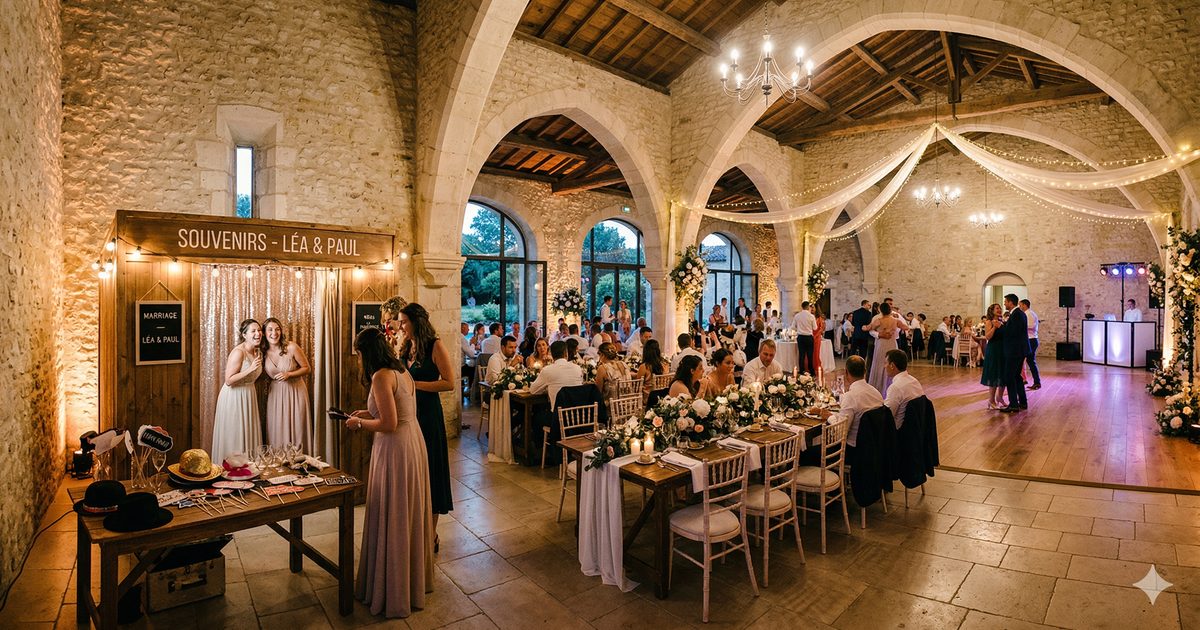
Location is 80% of the success
You can have the best photo booth in the world — a brand-new iPad, a well-configured app like Tronche!, carefully chosen props — and if you put it in the wrong place, nobody uses it. Not because guests didn't want to, but because they never really saw it, or because it wasn't practical to get to.
The basic rule: a photo booth goes where people already pass by, not where you hope they'll come.
The classic mistakes to avoid first
Before we talk about the good spots, here's what doesn't work.
The entrance hallway. Spoiler: the hallway is a no. People arrive, they're in the hugs-and-kisses phase, they're looking for the seating plan. Nobody stops for a photo at that moment. And by the end of the evening, the hallway is often empty or cluttered with coats.
Too close to the dance floor. The problem isn't being near the party — it's the noise and the movement. Guests can't hear each other give directions, the photos are blurry because someone is always moving, and the space is often too cramped for a group. A photo booth needs at least a little relative calm to work.
In a corner "so it won't get in the way." The number-one trap is thinking a discreet photo booth is a polite one. In reality, discreet = invisible = unused. If guests can't see it when they glance up from their table, it doesn't exist.
Against a wall with no prepared backdrop. A roughcast beige function-hall wall is rarely photogenic. Even a simple piece of fabric stretched behind it makes a real difference.
By venue type: where to set up your photo booth
In a château or country estate
Châteaux often have a connected layout — a grand hall, a drawing room, a library, a terrace. The ideal spot is usually the drawing room adjoining the main reception hall. Guests naturally retreat there to chat away from the noise, and they have time to pause for a couple of minutes for a photo.
A library or an alcove with wood panelling is even better: the backdrop is already gorgeous, you have nothing to do. Make the most of it. The château's daytime light, often softened by tall curtains, gives soft, flattering portraits.
Remember to check the nearest power socket — in old buildings, sockets are sometimes scarce and in unexpected places.
In a function hall
The classic function hall is often a large rectangular space with a bar on one side and a dance floor on the other. The photo booth is ideally placed near the bar, but not in it. The logic: guests go to the bar every hour, they sometimes wait 2–3 minutes, and that waiting time becomes a natural opportunity. They see the photo booth, and over they go.
As for the backdrop, in a function hall a bare wall is often unavoidable. A plain fabric (black velvet, white linen, gold organza depending on your theme) goes up in 5 minutes with two adhesive hooks. Nothing more.
Also check the artificial lighting in your chosen area. Function halls often have harsh ceiling lights that create unflattering shadows. A small ring light for €25–30 set on the tripod is enough to compensate.
In a garden or outdoors
An open-air wedding is gorgeous — and it's the scenario where the photo booth's location matters perhaps the most.
Natural daylight is perfect, but avoid direct, head-on sun (squinting eyes, washed-out skin in the photo). Look for a spot in light shade: under a tree, under a gazebo, in a covered passageway. Diffused light is the best lighting possible.
For the backdrop, a wall of greenery (a dense hedge, a flower bed, an ivy-covered wall) is unbeatable. If the garden doesn't have one, a flower arch rented for the occasion does exactly that job.
The outdoor-wedding trap: the wind. Cardboard props flying off, a fabric backdrop turning into a sail... Plan for weights, clips, or choose a rigid backdrop. And check that the nearest power socket is reachable if you need to recharge or use a ring light for the evening.
In a privately hired restaurant
In a restaurant, space is often tight. You can't move the tables, the aisles are narrow, and the owner has a say in where you hang what.
The best spot in this context is often next to the toilets' entrance. It sounds odd put that way, but it's a place everyone passes at least once during the evening, where there's usually a free wall, and where people are naturally on a break — so available for a photo.
Otherwise, the restaurant entrance or the cloakroom area at the end of the evening works well. People collect their coats, they wait for their friends — it's the perfect moment for one last keepsake photo.
The practical details that change everything
The power socket. Check it before settling on your final location. A tablet hitting 0% at 10 p.m. because you had no socket within reach is silly. If the socket is far, a discreet extension lead run along the wall is enough.
Room for groups. A wedding photo booth isn't just for couples. Big table groups stand up, families gather, childhood friends want a photo all together. Allow at least 1.5 metres of clearance between the lens and the backdrop — ideally 2 metres to fit 5–6 people. With Tronche!, the shared gallery collects every photo, whatever the size of the group.
Signage. A small "Photo Booth this way →" sign set on the nearest table, or hung on the wall, multiplies usage. People feel invited rather than intrusive. This simple detail is often the difference between 30 photos over the evening and 150.
Tripod height. For an iPad photo booth tripod — this 172 cm model suits it well — the right height is a standing adult's eye level — around 1.5 m–1.6 m. Too high and people look down in their photos, which is unflattering. Too low and they bend over awkwardly.
The test to run the day before
If you can get into the venue the day before or a few hours ahead, run this quick test: set up the tripod in the planned spot, take a test photo, and check three things — the light (is the subject well lit?), the backdrop (is the wall or fabric behind it clean?), and the space (is there room for 4–5 people side by side?).
If all three come back yes, you're in the right place.
And if you're starting from scratch and want a complete guide to setting everything up in 5 minutes, we've got that. For the props and accessories to set up alongside, there's also a list of original ideas that make a change from the eternal cardboard moustaches.
A good location is the kind of decision that takes 10 minutes to make and shapes the whole evening. Take the time to get it right — your guests will thank you in photos. And if you don't have the gear yet, take a look at our selection of tripods and ring lights to find the right setup.
This article contains Amazon affiliate links. Buying through these links supports Tronche! at no extra cost to you.